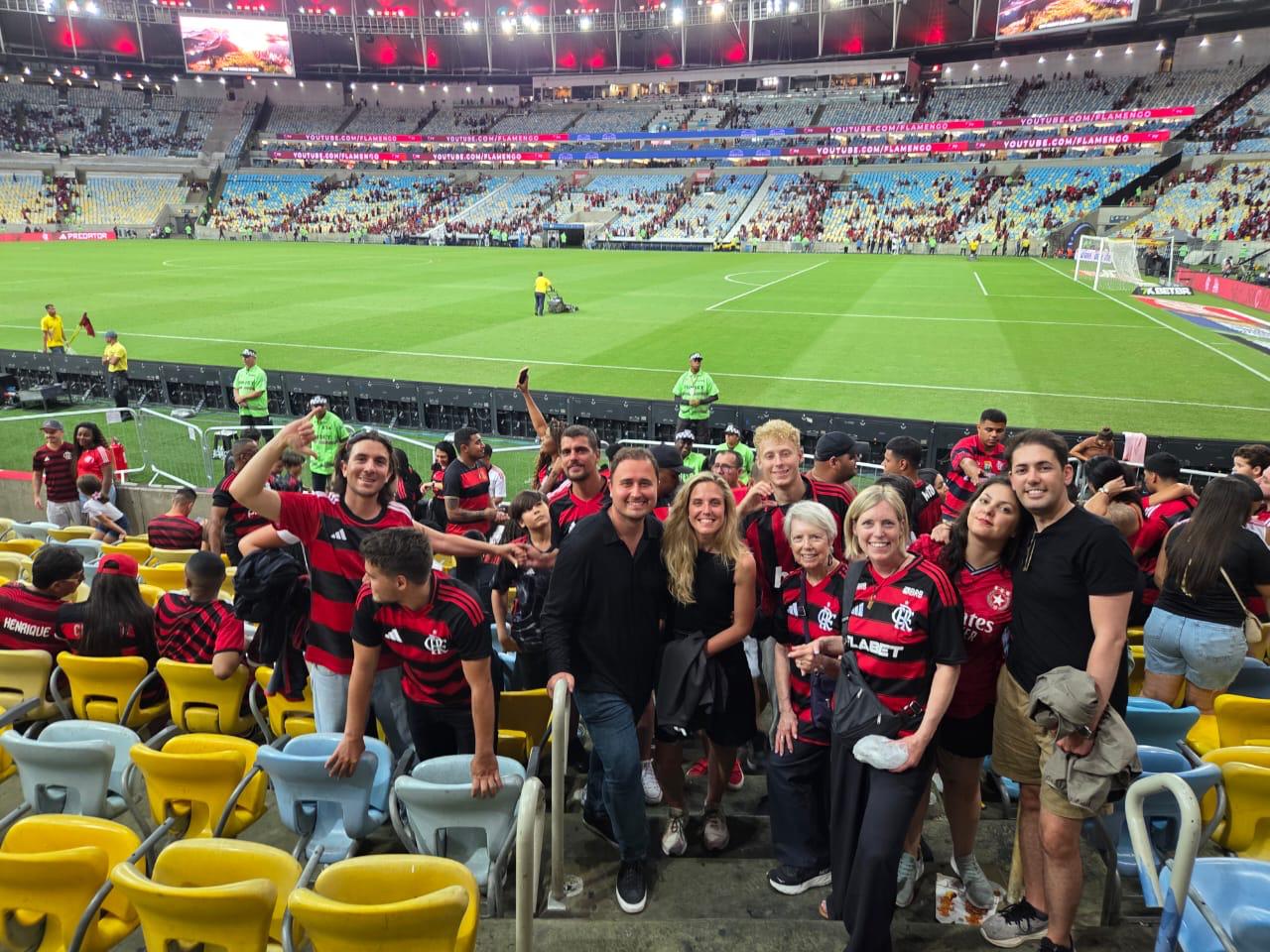
If you're planning a trip to Rio and football is on the list, the question isn't whether there'll be a match while you're here. There almost always is. The real question is which kind of match — a sun-soaked Sunday league game, a knockout Libertadores night under the lights, or a state derby with both ends of Maracanã packed with flags.
Rio has football basically year-round, but the texture of it changes month to month. Here's how to time it.
For the biggest matches and loudest atmosphere: come between August and November. The Brasileirão reaches its decisive stretch, the Libertadores knockout rounds are happening, and Maracanã sells out for almost every fixture.
For pleasant weather plus solid football: come in May, June, or July. Cooler evenings, fewer crowds, and a steady run of Brasileirão and Libertadores matches.
For unique local derbies you can't see any other time: come in January, February, or March, when the Campeonato Carioca is played.
Rio's Football Calendar, Explained
Unlike European leagues that run autumn-to-spring, Brazilian football runs roughly January through December, with no long summer break. That's good news for visitors: there's almost no month where Maracanã is dark for weeks at a time.
There are four competitions you'll encounter, and they overlap:
- Campeonato Carioca January → early April The Rio state championship — features all the local derbies (Flamengo vs Fluminense, Flamengo vs Vasco, Fla-Flu).
- Copa Libertadores February → November South America's biggest club competition. International opponents, knockout drama, the most electric nights at Maracanã.
- Copa do Brasil February → November The national cup. Single-leg or two-leg knockouts against clubs from across Brazil.
- Brasileirão Série A Late March/April → December The Brazilian league. The main event most weekends — title race, relegation battles, continental qualification.
Flamengo and Fluminense — the two clubs that share Maracanã — are typically active in three or four of these at the same time. That's why a single week in Rio can offer a Libertadores group game on Tuesday, a Copa do Brasil knockout on Wednesday, and a Brasileirão fixture on Sunday.
Month-by-Month Guide
Carioca Season & Brazilian Summer
Rio is hot, humid, and full of life. It's high season for tourism, with Carnival hitting in late February or early March. Football-wise, you're in Campeonato Carioca territory — the state league. The early rounds against smaller clubs are usually relaxed affairs at Maracanã, with shorter lines, lower ticket demand, and a chance to see the giants play at home for an affordable matchday.
Late February also brings the opening rounds of the Libertadores, which means international opponents from Argentina, Uruguay, Colombia, or Chile traveling to Rio. Those nights have a different energy.
Carioca Finals & Brasileirão Kickoff
The Carioca enters its final stages — semifinals and finals — and this is where the atmosphere ramps up sharply. A Flamengo vs Fluminense or Flamengo vs Vasco final is one of the loudest matchday experiences in world football. These games sell out fast.
By mid-April, the Brasileirão kicks off and runs alongside the Libertadores knockouts. You'll find midweek Libertadores fixtures and weekend league games on a regular cadence. Weather starts cooling slightly, and the rains ease.
The Sweet Spot for Comfort
This is Rio's mild season. Daytime highs sit in the mid-to-high 20s°C (high 70s°F), evenings are cool, and rain is rare. The city is calmer, hotels are cheaper, and the football keeps coming.
At Maracanã, you'll find a steady stream of Brasileirão fixtures, Copa do Brasil knockouts, and Libertadores group games. The biggest derbies aren't usually concentrated here, but Flamengo or Fluminense are at home roughly every weekend, often twice a week.
Things Get Serious
The Brasileirão enters its decisive second half. Libertadores moves into the round of 16, then quarterfinals. Copa do Brasil enters its late knockout stages. Suddenly every match matters — for the title, for a continental spot, for survival from relegation.
Crowds get louder. Ticket demand climbs. The biggest fixtures — Flamengo vs Palmeiras, Flamengo vs São Paulo, the Fla-Flu derby — start drawing 60,000+ crowds with full choreographies and tifos. Weather is still dry and mild, ideal for evening kickoffs.
Knockout Nights & Title Run-In
This is, on balance, the single best time of year to plan a football trip to Rio. The Brasileirão title race is in full swing, the Libertadores reaches its semifinals and final, and Copa do Brasil delivers its final stages. Maracanã hosts knockout fixtures almost every week.
The atmosphere on a Libertadores semifinal night at Maracanã is, simply, unmatched. The fireworks before kickoff, the chants that don't stop for two hours, the flags that cover entire stands — it's the version of Brazilian football you've seen in highlight reels.
Weather is warming back up but not yet at peak summer intensity. Days are long, evenings are perfect for a pre-match bar stop.
Final Matchdays & Early Summer
The Brasileirão wraps up in early December. Title-deciding matches can fall on the final weekend, and if Flamengo or Fluminense are in contention, those games are unforgettable. After mid-December, the league pauses for the off-season — but pre-season friendlies and early Carioca fixtures can still appear at Maracanã as the new year approaches.
Christmas and New Year's are peak tourism weeks in Rio, with Réveillon at Copacabana drawing millions. Matches in this window are rarer but charged with end-of-year drama.
A Quick Note on Weather vs Football
If your trip is short and you want to optimize for the most reliable atmosphere, the football calendar matters more than the weather calendar. Evenings at Maracanã are pleasant year-round, and a packed stadium feels the same in February as it does in October.
That said, the Rio months that combine good weather and meaningful football are May through November. Outside that window you can still have a brilliant matchday — it just rains more, or the matches are lower-stakes Carioca opening rounds.
How to Plan Around the Fixtures
Brazilian football has one quirk worth knowing about: the Brazilian Football Confederation (CBF) often confirms exact kickoff times only two to three weeks before the match, sometimes shifting them later for broadcaster reasons. That means you usually can't lock in a Rio trip 6 months ahead around one specific match — but you can plan a window and trust that there will be matches in it.
The practical move:
- Pick your travel window first — a one-week or two-week window works well.
- Check the upcoming fixtures at Insider Adventures Upcoming Games once you're within about a month of travel.
- Book your matchday package as soon as the fixture is confirmed for your dates.
If a kickoff time shifts after you've booked, our team monitors every fixture and updates you automatically — including pickup time — or moves you to another match the same week if needed.
What "Going to a Match in Rio" Actually Looks Like
For a foreign visitor, attending a match at Maracanã isn't quite as simple as showing up. Brazilian law requires a CPF (a national tax ID issued only to residents) and pre-registered facial biometrics for stadium entry. Both are hard walls that the DIY route can't cross.
The way most visitors do it: book a guided matchday package. With Insider Adventures, that means:
- Pickup from Copacabana Palace in a climate-controlled van — no metro crowds, no taxi negotiation.
- Pre-match stop at a local bar where Brazilian fans gather before every game — cold beers, BBQ, samba, and chants.
- English-speaking guide who walks you through chants, rivalries, and matchday culture.
- Home-crowd tickets in a quality section, confirmed by email or WhatsApp before kickoff.
- Full assistance with biometric registration — it takes about two minutes from your phone.
- Round-trip back to Copacabana when the final whistle blows.
You can read the full breakdown in our guide on how to buy Maracanã tickets as a tourist.
Final Word
If you want the simplest possible recommendation: plan your Rio trip for sometime between August and November, ideally on a week with a Libertadores or Brasileirão home fixture for Flamengo or Fluminense. You'll get warm-but-not-melting weather, a packed Maracanã, and a matchday atmosphere that ranks among the best in world football.
But there's no wrong month, really. Rio plays football all year. Whichever week you land in, there's a good chance there's a match waiting — and a seat in the home end with your name on it.