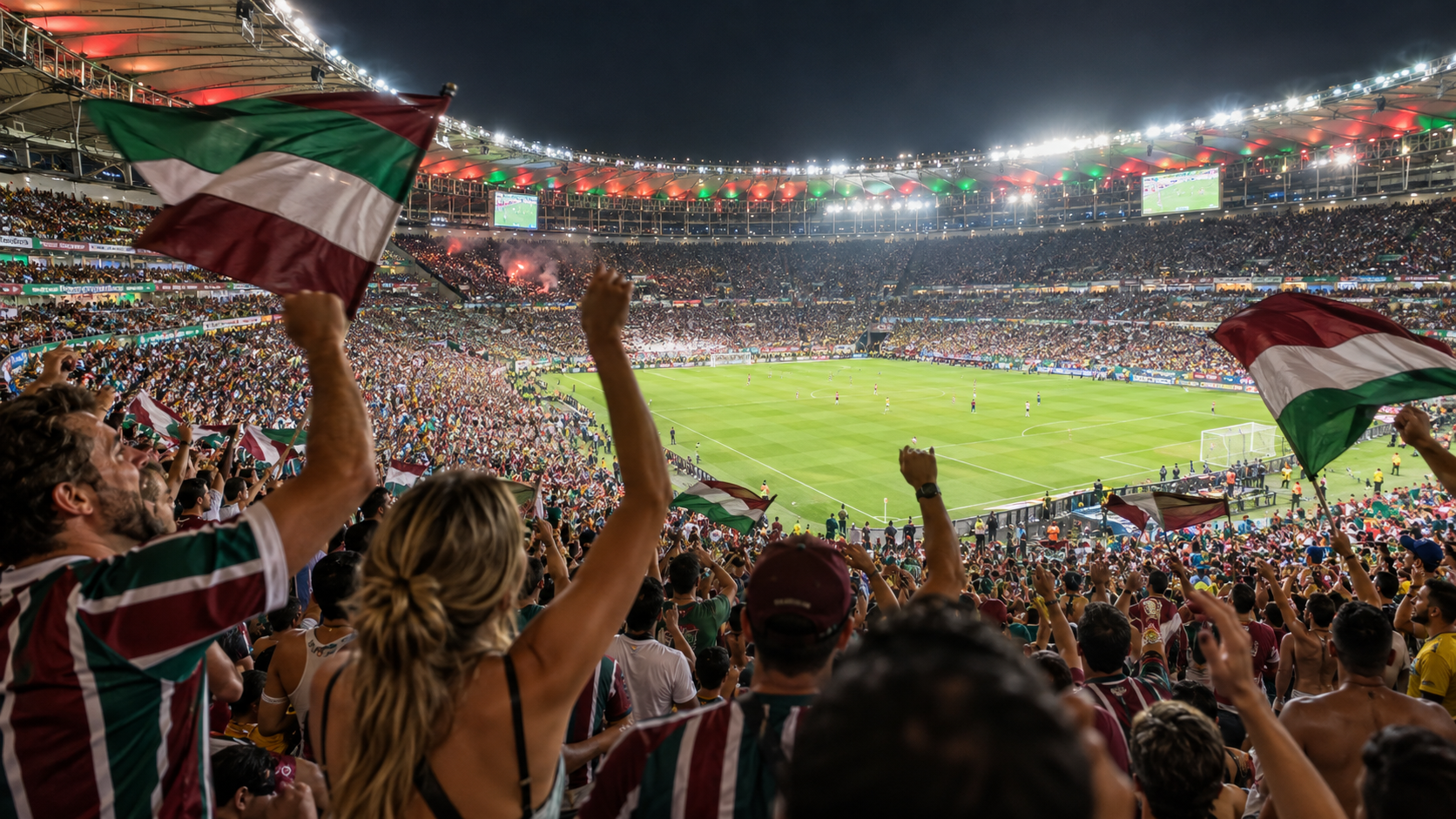
You have seen the videos: thousands of fans singing, flags moving across the stands, drums echoing around the stadium and an entire crowd exploding when the ball hits the net. But what is a Brazilian football matchday actually like when you experience it for the first time?
For a tourist visiting Rio de Janeiro, watching Flamengo or Fluminense at Maracanã is very different from simply arriving at a stadium five minutes before kickoff.
The match itself lasts around 90 minutes. The experience starts much earlier.
From the pre-match gathering and the journey to Maracanã to the chants, facial recognition entry, food, supporters and final whistle, this guide explains what to expect at a football match at Maracanã.
A Brazilian football matchday at Maracanã is part sporting event and part cultural experience. Expect passionate supporters, loud chants, team colors, crowded surroundings, a lively pre-match atmosphere and intense reactions throughout the game. Tourists should also be prepared for match-specific entry procedures, including facial registration, and should plan transportation before and after the match. With Insider Adventures, the experience is organized from the meeting point to the return journey.
Brazilian Football Matchday Is More Than 90 Minutes
One of the biggest differences international visitors notice is that Brazilian football does not begin when the referee blows the whistle.
Matchday starts hours earlier.
Friends meet for drinks. Supporters wear their club shirts around the city. Groups begin singing before reaching the stadium. Bars near Maracanã fill with fans discussing the lineup, previous matches and what they expect to happen that night.
As kickoff gets closer, thousands of people begin moving toward the stadium at the same time.
That build-up is part of the experience.
If you only arrive at your seat just before kickoff, you have technically attended the match. But you have missed an important part of Brazilian football culture.
1. Before the Match: The Meeting Point
For guests joining Insider Adventures, matchday begins away from the stadium.
The group meets at an organized meeting point in Copacabana before traveling together toward Maracanã.
This is also where visitors meet the guide and other travelers who will experience the match with them.
For many tourists, especially those attending their first South American football match, this immediately removes one of the biggest uncertainties:
How do I actually get to Maracanã on matchday?
Rio traffic and transportation patterns can change significantly when tens of thousands of supporters are heading toward the same stadium. Having transportation arranged in advance means you do not need to improvise your journey while trying to understand an unfamiliar city.
The Maracanã football experience includes match entry, organized private transportation and local guidance, allowing you to focus on the football rather than matchday logistics.
2. The Pre-Match: Where the Experience Really Begins
Before entering Maracanã, you start noticing that this is not going to feel like an ordinary tourist attraction.
The streets around the stadium become part of the event.
Fans gather in groups wearing their club colors. Vendors appear. Conversations become louder. Songs begin. You may hear the same chants that will later fill the stadium being sung outside long before the teams enter the pitch.
A traditional Brazilian football pre-match can involve:
- Meeting other supporters
- Having a cold beer
- Brazilian barbecue or street food
- Discussing the match and starting lineup
- Learning the club's chants
- Taking photos before entering the stadium
For someone visiting from another country, this part can be just as interesting as the football itself.
You begin to understand that Flamengo and Fluminense are not simply teams people watch. They are communities that supporters identify with throughout their lives.
3. Expect a Lot of Team Colors
You will immediately notice shirts everywhere.
At a Flamengo home match, red and black dominate the surroundings. At a Fluminense match, expect the club's traditional green, white and burgundy colors.
For tourists, wearing the home team's colors can be part of the fun, but you do not need to purchase a shirt to attend.
If you are unsure what to wear, neutral clothing is usually the simplest option until you receive the specific match instructions.
The most important rule is to avoid casually wearing the colors or shirt of a rival club without understanding the context of the match and the section you are entering.
4. Arriving at Maracanã
Then the stadium appears.
Even if you have already visited Maracanã during the day, arriving when tens of thousands of football supporters are entering creates a completely different impression.
There are people everywhere.
The stadium lights are on. Police and event staff manage crowd movement. Vendors surround the area. Supporters move toward different access points depending on their tickets and sectors.
This is one reason arriving with enough time matters.
Matchday is not the moment to discover that you are at the wrong entrance five minutes before kickoff.
5. How Do You Enter Maracanã?
One part of the experience that can surprise foreign tourists is the stadium access system.
For current matches at Maracanã, facial biometric registration is an important part of the entry process. The exact ticketing and registration instructions depend on the club and fixture, so visitors should always follow the information provided specifically for their match.
Instead of treating this as something to solve when you arrive at the stadium, complete every required registration step in advance.
When you reach the access point, follow the instructions provided for your ticket and entry sector.
If you want to understand this process in more detail, read our guide to facial registration at Maracanã.
Insider Adventures provides guests with matchday instructions and assistance with the required access process before the game, so you know what to expect before reaching the stadium.
6. The Moment You Walk Into the Stadium
This is usually when everything changes.
You leave the corridors and suddenly see the pitch, the stands and tens of thousands of supporters in front of you.
For many travelers, this is the moment they realize that watching a match at Maracanã is completely different from visiting the stadium on a normal sightseeing tour.
An empty stadium can show you the architecture.
A match shows you what Maracanã is actually for.
Depending on the fixture, you may see giant flags, banners, coordinated displays and entire sections already singing before kickoff.
7. What Are the Fans Like?
Brazilian supporters are expressive.
Expect people around you to stand up, sit down, shout instructions at players, celebrate tackles, complain about the referee and react emotionally to almost every major moment.
And expect singing.
A lot of it.
Some chants last only a few seconds after an important play. Others spread across sections of the stadium and continue repeatedly throughout the match.
You do not need to know Portuguese to understand the emotion behind them.
By the second half, you may even recognize a few.
8. Drums, Flags and Brazilian Supporter Culture
One of the characteristics that makes a Brazilian football match memorable for foreign visitors is how much of the atmosphere is created by the supporters themselves.
Depending on the fixture and section, you may encounter:
- Large flags
- Drums and percussion
- Continuous chants
- Coordinated clapping
- Thousands of supporters jumping together
- Large visual displays during important matches
The atmosphere can become especially intense during derbies, knockout matches and important league fixtures.
A Flamengo vs Fluminense match, for example, feels very different from a regular early-season fixture.
This is why tourists planning a football experience in Rio should think not only about which stadium to visit, but also which match to attend.
9. Where Will You Sit?
Your section changes how you experience the match.
Seats along the East and West sides generally provide a broader view of the pitch, while supporter areas behind the goals can place you closer to the most intense parts of the crowd.
If atmosphere is your priority, you may prefer being closer to the home supporters.
If seeing the entire pitch clearly matters more, a side section may be more appropriate.
We explain these differences in detail in our guide to the best seats at Maracanã for tourists.
10. What Happens When the Teams Enter?
The minutes immediately before kickoff are often some of the best moments of the night.
The noise level rises.
Phones appear everywhere.
Supporters begin singing louder.
The players walk onto the pitch and the stadium suddenly feels much smaller because everyone's attention is focused on the same place.
For major fixtures, this is when you may see some of the biggest displays from the crowd.
If you want to film part of your experience, make sure your phone has enough battery before arriving. But do not watch the entire match through your screen.
Some moments are much better experienced than recorded.
11. What Is the Match Itself Like?
Once the game begins, the crowd responds constantly to what happens on the pitch.
A dangerous attack can make thousands of people stand simultaneously.
A controversial referee decision can produce an immediate wall of noise.
A missed opportunity creates collective frustration.
And then there is the goal.
If the home team scores, everything around you can change in seconds.
People hug friends. Strangers celebrate together. Beer flies. The noise becomes significantly louder and chants begin immediately.
For tourists who have attended football matches in Europe, North America or elsewhere, the rules on the pitch are obviously the same.
The social experience around you may feel completely different.
12. Do You Need to Understand Portuguese?
No.
You can enjoy a Brazilian football match without speaking Portuguese.
The game itself needs no translation, and much of the atmosphere is visual and emotional.
However, having a local guide adds context.
You can understand why the supporters are singing a particular song, which players the crowd loves, why a rivalry matters and what is happening around the stadium that might otherwise look confusing.
That context can turn a football match into a cultural experience.
13. Halftime at Maracanã
When the first half ends, the stadium does not suddenly become quiet.
People discuss what happened, check other scores, buy food or drinks and debate what the team needs to change.
Lines around food and beverage areas can become busier during this short period, so plan accordingly.
Then the players return and the entire rhythm starts again.
14. What Happens After the Final Whistle?
The experience does not finish instantly when the referee ends the game.
The result changes the mood dramatically.
After a victory, supporters may continue singing as they leave. After a painful defeat, the atmosphere can be noticeably different.
Either way, tens of thousands of people are leaving the area at roughly the same time.
This is where transportation planning becomes particularly important.
Ride-app demand can increase, streets can become crowded and visitors unfamiliar with the neighborhood may find the post-match flow confusing.
An organized return journey means you already know what happens next instead of trying to solve transportation outside the stadium with thousands of other people.
A Brazilian Matchday, Step by Step
| Stage | What to Expect |
|---|---|
| Before departure | Meet your group, guide and receive final matchday instructions |
| Journey to Maracanã | Traffic, supporters and increasing matchday atmosphere |
| Pre-match | Fans, drinks, food, chants and local football culture |
| Stadium arrival | Large crowds, designated entrances and security procedures |
| Entry | Match-specific ticket and facial biometric access procedures |
| Before kickoff | Flags, songs, team warmups and rising crowd intensity |
| The match | 90+ minutes of chants, emotion and Brazilian football |
| Final whistle | Thousands of supporters leaving the stadium together |
| Return | Organized transport back from the match |
What Should You Bring to Maracanã?
Keep matchday simple.
- Bring the identification required in your match instructions
- Charge your phone before leaving
- Wear comfortable clothes and shoes
- Travel light
- Bring only essential personal items
- Follow the instructions provided for your specific fixture
Stadium rules and permitted items can change, so avoid assuming that something allowed at a football stadium in your country will automatically be permitted at Maracanã.
What Should You Wear?
Comfort matters.
Rio can be warm even for evening matches, and a matchday involves walking, standing and spending several hours away from your accommodation.
Sneakers and lightweight clothing are usually practical.
If you want to wear a football shirt, make sure it is appropriate for the home team and your section.
When in doubt, neutral colors are the simplest choice.
Is a Maracanã Match Worth It If You Are Not a Huge Football Fan?
Yes, if what interests you is experiencing Rio rather than simply watching football.
You do not need to know every Flamengo player or understand the history of Fluminense to appreciate 50,000 or more people reacting together inside one of the world's most famous football stadiums.
For many travelers, the football is only one part of what makes the night memorable.
The supporters, songs, food, colors, movement around the city and collective emotion are what transform the game into a cultural experience.
This is one reason a Maracanã match can work for couples, groups of friends and families even when only one person in the group is a serious football fan.
Going Alone vs Joining an Organized Matchday Experience
It is possible to organize different parts of a Maracanã visit independently.
But tourists then need to understand the ticketing process, registration requirements, appropriate sections, transportation, stadium entrances and post-match logistics themselves.
For visitors who have limited time in Rio, an organized experience removes much of that friction.
Insider Adventures combines match entry, private round-trip transportation and local guidance into one experience. Guests can enjoy the pre-match atmosphere, enter Maracanã with clear instructions and return after the final whistle without having to organize each part separately.
Which Maracanã Match Should You Choose?
Not every football match produces exactly the same atmosphere.
Your experience can depend on:
- The home team
- The opponent
- The competition
- The importance of the fixture
- Expected attendance
- Whether the match is a derby
- Whether it is a knockout game
A regular Brasileirão match can already offer a fantastic atmosphere.
A Fla-Flu derby or an important Copa Libertadores night can take the experience to another level.
The best approach is to check which Flamengo and Fluminense matches coincide with your dates in Rio rather than choosing a game based only on the team name.
Check the current Maracanã schedule and find the football match that fits your trip.
Frequently Asked Questions
What is a Brazilian football matchday like?
A Brazilian football matchday usually extends far beyond the 90-minute game. Supporters meet before kickoff, wear club colors, eat and drink together, sing chants and create an atmosphere that continues inside the stadium throughout the match.
How early should tourists arrive at Maracanã?
Do not plan to arrive just before kickoff. Traffic, crowds, stadium entrances and access procedures all require time. If you are attending through an organized experience, follow the meeting and departure time provided for your specific match.
Do tourists need facial registration to enter Maracanã?
Facial biometric access is currently used for matches at Maracanã. Registration and ticketing procedures can vary depending on the home club and specific fixture, including procedures for foreign visitors. Always complete the instructions provided for your match before arriving at the stadium.
Can I attend Maracanã if I do not speak Portuguese?
Yes. You do not need Portuguese to enjoy the football and atmosphere. However, a local guide can help explain chants, rivalries, supporter culture, stadium procedures and what is happening around you during the experience.
Can tourists wear football shirts at Maracanã?
Yes, but you should know which team and section you are joining. Avoid wearing the colors of a rival club without understanding the match context. When in doubt, neutral clothing is a simple option.
Is a Maracanã match good for someone who is not a football fan?
It can be. Many visitors enjoy Maracanã because of the atmosphere, Brazilian culture, chants and scale of the event rather than only the football itself.
What happens after a match at Maracanã?
Thousands of supporters leave the stadium at the same time, so surrounding streets and transportation can become busy. Planning your return before the game is recommended. Organized matchday experiences include a defined plan for leaving the stadium and returning after the match.
How can I watch a Flamengo or Fluminense match at Maracanã?
Check which home matches take place during your stay in Rio. Insider Adventures offers organized Maracanã experiences for selected fixtures with match entry, private transportation and local guidance.
Experience the Matchday, Not Just the Match
You can watch Brazilian football on television anywhere in the world.
What you cannot reproduce on a screen is the moment you approach Maracanã surrounded by supporters.
The first chant you recognize.
The noise when the teams enter.
The stranger next to you celebrating a goal as if you have known each other for years.
The streets filling again after the final whistle.
That is Brazilian matchday.
And if you are already coming to Rio de Janeiro, experiencing it inside Maracanã is one of the closest ways to understand why football occupies such an important place in Brazilian culture.
Find a Flamengo or Fluminense match during your stay in Rio and experience Brazilian football with Insider Adventures.